The Voynich Manuscript
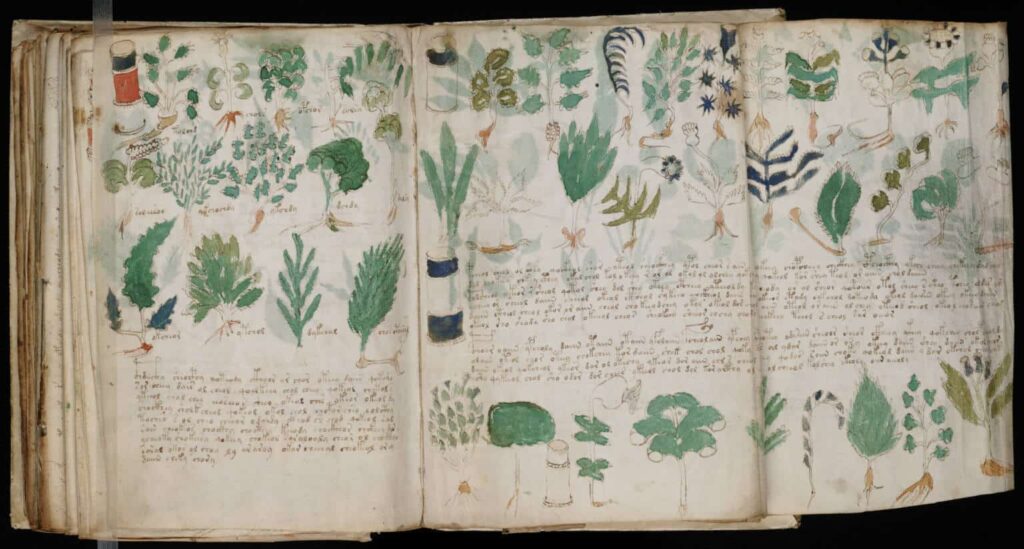
The Voynich Manuscript is a captivating and mysterious artifact, often regarded as one of the most perplexing enigmas in the world of ancient manuscripts. This illustrated codex, believed to date back to the 15th century, is written in an unknown script and language that has eluded decipherment for centuries. Despite the best efforts of some of the world’s most brilliant codebreakers, linguists, and cryptographers, the meaning and content of the Voynich Manuscript remain a mystery.
The manuscript’s pages are adorned with a series of bizarre and intricate illustrations that add to its mystique. These drawings include a vast array of plants, many of which do not correspond to any known species, astronomical diagrams that defy conventional understanding, and a plethora of unknown symbols and shapes that seem to follow no recognizable pattern. The manuscript’s art, with its whimsical and otherworldly depictions, provides an almost dreamlike quality, further intriguing researchers and enthusiasts.
Numerous theories have been proposed regarding the manuscript’s origins and purpose. Some speculate that it could be a herbal manual, an alchemical text, or even a coded work of pure invention. Others suggest that it may have been created as a hoax or as an attempt to produce a new, unbreakable code. Despite extensive study and advanced technological analysis, including the use of modern computational methods, the manuscript has resisted all attempts at translation and understanding.
The allure of the Voynich Manuscript lies not only in its undeciphered text but also in the profound sense of mystery it evokes. It serves as a testament to the enduring human fascination with the unknown and the limits of our understanding. As scholars continue to study this enigmatic codex, the Voynich Manuscript remains a tantalizing puzzle, inviting new generations to unlock its secrets.